Personalizing Mental Health Support
A Retrieval-Based LLM Approach to Conversational Agent Development
Abstract
Mental health disorders constitute a major global challenge, requiring support solutions that are both accessible and scalable. Conversational agents have emerged as promising tools in this context, but purely generative large language model (LLM) systems remain susceptible to unsupported outputs, weak grounding, and limited adaptation to user-specific context. This work investigates whether combining supervised domain adaptation, guideline-grounded retrieval, and persona-based conditioning improves the quality of emotional-support responses. Three system variants built on the same fine-tuned Llama-3 backbone are compared: a Baseline model controlled through layered prompting, a Hybrid Retrieval-Augmented Generation (RAG) variant grounded in authoritative WHO and NICE mental health guidelines through hybrid retrieval, and a Persona-Based RAG variant that further incorporates persona signs into both retrieval and prompt construction. All variants are protected by a pre-LLM crisis guardrail that short-circuits high-risk inputs and returns a predefined safe response. Evaluation was conducted in a single-turn setting using inputs from mental health datasets associated with multiple persona profiles, and outputs were assessed through both human evaluation and an LLM-as-a-judge protocol under a shared rubric covering empathy, topic adequacy, and personalization. Results from both evaluation sources converge in identifying the Persona-Based RAG variant as the best overall configuration, with the clearest gains in empathy and personalization, while the RAG-only variant remained especially competitive in topic adequacy. These findings indicate that combining grounded retrieval with explicit persona conditioning is a promising strategy for the development of more contextually appropriate and supportive conversational agents for mental health.
Video
Further information
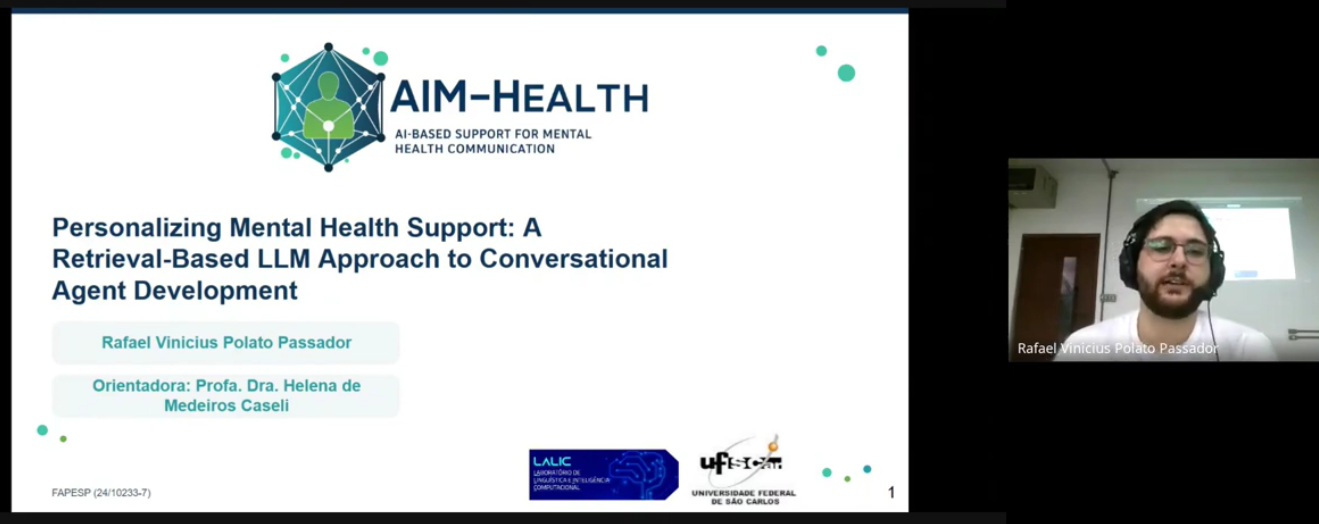
The Master’s Dissertation Defense by Rafael Vinicius Polato Passador took place on April 24, 2026 and the commitee was composed of Professors Altigran Soares da Silva (UFAM), João Paulo Papa (UNESP) and the advisor Helena Caseli (UFSCar).
Master Thesis
PASSADOR, Rafael Vinicius Polato. Personalizing mental health support: a retrieval-based llm approach to conversational agent development. 2026. Dissertação (Mestrado em Ciência da Computação) – Universidade Federal de São Carlos, São Carlos, 2026. Disponível em: https://repositorio.ufscar.br/handle/20.500.14289/24064.